

 Posts
Posts


 Does Judge Reggie Walton have a heart of stone? Reading the sentencing letters written by Scooter Libby's friends, how could one not be moved? If a man can be judged by the friends he has, then it is difficult to look harshly on someone who numbers among his friends such stalwart men of impeccable reputations as Donald Rumsfeld, Paul Wolfowitz, Henry Kissinger, John Bolton, Richard Perle and Douglas Feith. (Vice President Dick Cheney did not get around to writing a letter for his former aide, but I'm sure he was very busy.)
It is beyond me how Judge Walton could ignore the pleadings of Henry Kissinger, for example, who wrote, "Having served in the White House and under pressure, I have seen how difficult it sometimes is to recall precisely a particular series of events." Just think of all the deeds that Kissinger has had to block from his mind and you can see that Libby's small lapses of memory were minor in comparison. Paul Wolfowitz wrote about how Libby worked late into the night to protect the identity of a covert CIA agent, whose name had not yet been leaked to Robert Novak. But there was no more affecting letter than the one written by Mary Matalin and signed by her husband James Carville, who apparently was so moved by Libby's plight that he was willing to sacrifice all credibility he will ever have with Democrats.
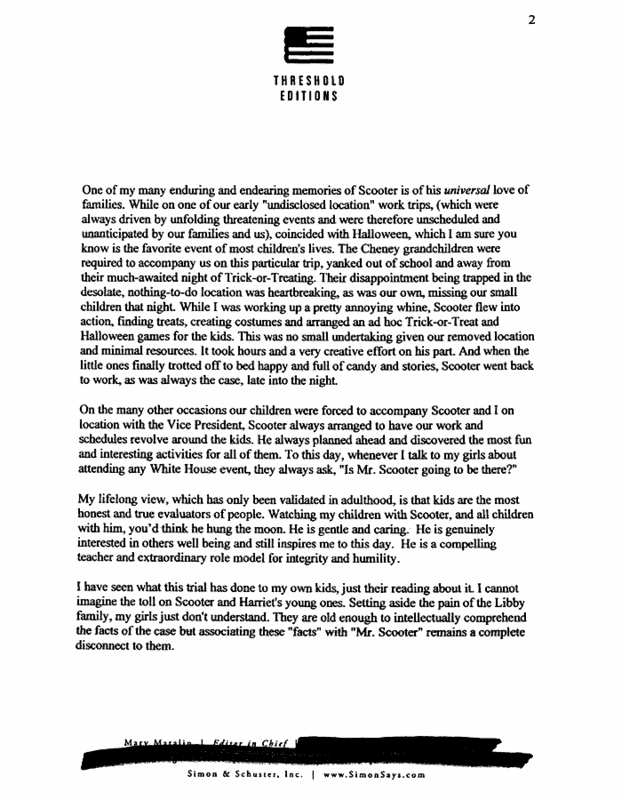
Matalin tells us of an occasion when she accompanied the Cheney family to one of the "undisclosed locations" they had to escape to in order to flee from the terrorists:
"One of my many enduring and endearing memories of Scooter is of his universal love of families. While on one of our early "undisclosed location" work trips (which were always driven by unfolding threatening events and were therefore unscheduled and unanticipated by our families and us), coincided with Halloween, which I am sure you know is the favorite event of most children's lives. The Cheney grandchildren were required to accompany us on this particular trip, yanked out of school and away from their much-awaited night of Trick or Treating. Their disappointment at being trapped in the desolate, nothing-to-do location was heartbreaking, as was our own, missing our small children that night. While I was working up a pretty annoying whine, Scooter flew into action, finding treats, creating costumes and arranged an ad-hoc trick-or-treat and Halloween games for the kids. This was no small undertaking given our removed location and minimal resources. It took hours of creative effort on his part. And when the little ones finally trotted off to bed full of candy and stories, Scooter went back to work, as was always the case, late into the night."
It is an image I will not soon forget: Scooter Libby in a remote military installation scaring children. Matalin does not tell us what kind of Halloween costumes Libby found or what kind of scary stories he told, but I already have a picture in my mind. I imagine Matalin in a witch costume, Carville dressed as a scarecrow and Libby playing Death, dressed in long black robes and a black hood with only his eyes visible when the candlelight hit them in the dark caverns of the secret underground military installation. Dick Cheney probably wore a Dick Cheney mask.
How the children must have screamed with delight as he regaled them with frightening tales of the torture chambers of petty dictators, mushroom clouds in American cities and liberals hiding under their beds. I can almost hear their piercing screams when he shouted, "It's coming from inside the house!" It must have brought him great joy to see them shiver with fright as he told them of villages reduced to rubble, burying some of the inhabitants alive while others dragged themselves through the destruction like zombies with missing limbs and eyeballs hanging from their sockets. Or perhaps he read Edgar Allen Poe's "The Tell-Tale Heart," looking slightly mad as he told them of the murdered man's heart beating "louder! louder! louder! LOUDER!" and the guilty protagonist's agonized confession: "Dissemble no more! I admit the deed! -- tear up the planks! -- here, here! -- it is the beating of his hideous heart!"
As he looked into the eyes of the children, giddy with terror, munching on the bits of candy he was able to scrape up from military rations, I'm sure he thought of the poor little children halfway across the world in Iraq who would not be celebrating Halloween that night because they lived under the yoke of a dictator in a benighted society that knew nothing of the joys of Halloween. They lived in a place where children were deprived of the pleasure of going from house to house once a year to beg for candy or of being scared to death by tales of terror. When he went back to work that night, I'm sure he toiled with a renewed vigor, as he dedicated himself selflessly to his mission--to bring Halloween to all the children of the world.
"Kids are the most true and honest evaluators of people," Matalin wrote in her letter, documenting the devastating toll the prosecution of "Mr. Scooter," as her children called him, has had on her family. I hope that Judge Walton will reconsider the harsh sentence he has imposed on Scooter Libby or that President Bush will pardon him. I hope that they will think of the children.
Photo by A Look Askance.
Share This Post


Technorati Tags: Jon Swift, Cheney, Scooter Libby, Mary Matalin, James Carville, Henry Kissinger, Halloween, Iraq, Politics
Thursday, June 07, 2007
Scooter Libby's Halloween

Thursday, March 22, 2007
Why Can't the President Fire Everyone?
 Democrats are making a big deal out of the firing of few prosecutors who are appointed by the President and "serve at the pleasure of the President" or lack thereof as the case may be. Critics say that Attorney General Alberto Gonzales has been trying to politicize the Justice Department, but blogger and Charleston (West Virginia) Daily Mail columnist Don Surber thinks the department should be politicized, and so should the rest of the government. "Of course these firings were political," he writes. "Their hirings were political. It is all political. That is why we vote. We elected President Bush to be the chief executive of this government. He should be able to fire anyone."
I thought President Bush could fire anyone, but he was just extremely reluctant to do so even when someone screws up. But it turns out that there are a bunch of people in the government he can't fire. "Unfortunately, we have Civil Service, which protects most federal employees from being fired," Surber explains. "This makes it difficult to have the government serve the people."
I did a little research into this government cabal called Civil Service and it turns out that things were not always this way. Back in the early nineteenth century when everything was better in this country for everybody, except for blacks, women and apparently civil servants, everyone in the government served at the pleasure of the President and anyone could be fired at any time for any reason. Under the "spoils system" after a party won an election it could give away all the government jobs to its own people. When a new President was elected he fired all the government workers and replaced them with his supporters. Back then Presidents believed, as President Bush and Gonzales do now, that loyalty was a lot more important than merit.
Unfortunately, these happy days of patronage ended with the passage of the Pendleton Act of 1883. The act was passed in the wake of James Garfield's assassination by Charles Guiteau (pictured above), who was angry that he got passed over for a job for which he had no qualifications. This act set up the Civil Service Commission, which awarded jobs based on merit. (The law didn't apply to state governments where political machines continued to give out patronage jobs well into the 20th century) In 1939 the Hatch Act barred federal employees from engaging in partisan politics and eliminated the spoils system for all but the most senior positions. Except for a brief interlude during the McCarthy era when civil servants could be fired if they were perceived to be disloyal or gay, it has been very difficult fire government workers unless you have a good reason.
Unfortunately, the creation of Civil Service led to the federal government becoming too powerful. When federal workers were incompetent, government was weak and didn't bother people that much. But once the government was filled with people who knew how to do their jobs, the government became too strong. President Bush has done what he could to weaken the power of government bureaucracies by restoring some of the incompetence that was lost, but there is only so much one man can do in six years. Although people like Alberto Gonzales, Donald Rumsfeld and Michael Brown made great strides in weakening the bureaucracies they supervised, a lot more needs to be done.
President Bush would not only like to decrease the power of the bureaucracy but also increase his own power as well under the theory of the Unitary Executive, which says there should be limits on the power of Congress and that the President should be given powers that no other branch of government can interfere with. That is why he is citing Executive Privilege to resist Congress' efforts to get Karl Rove and Harriet Myers to testify under oath. If his advisers are subjected to "show trials" under "klieg lights," as he put it in his press conference the other day, then Congress might decide it can take away the power it gave him to conduct secret military tribunals for those he has personally dubbed enemy combatants and curtail his ability to decide who can be subjected to harsh interrogation methods.
President Bush has drawn a line in the sand by resisting Congress' attempt to wrest power from him, precipitating a Constitutional showdown. Vice President Cheney knows from first-hand experience how the power of the President was dangerously weakened in the Nixon era. In United States v. Nixon the Supreme Court rebuffed President Nixon's attempts to withhold the Watergate tapes by saying that Executive Privilege can be invoked only to "protect military, diplomatic, or sensitive national security secrets." If Congress insists on taking this case all the way to the Supreme Court, the Court should reverse this terrible precedent. Even if they don't have the guts to reverse it, they should at least rule in Bush's favor since virtually everything he and Vice President Cheney do is a national security secret. "The Constitution is at stake," says Surber. "It puts the executive branch under a president's control. Congress needs to be put in its place."
Only with a weak bureaucracy and a strong executive will President Bush be able to fight the terrorists. A victory in the Supreme Court will be just the first step to restoring the President's power and taking it away from the bureaucrats. The entire Civil Service system also needs to be reformed so that the President can fire anyone he thinks is disloyal the way it was during the McCarthy era and before the passage of the Pendleton Act. Then government will be better able to "serve the people," as Surber put it. Surber is also right when he says the President "should be able to fire anyone." In fact, the President should have the power to fire members of Congress and members of the Supreme Court as well. Only then will the President have successfully neutralized the threat of those inside the government who have weakened us in the War on Terror.
Share This Post
Technorati Tags: Jon Swift, Alberto Gonzalez, Don Surber, Justice Department, Terrorism, Bush, Cheney, Nixon, Civil Service, McCarthy, Rumsfeld, Politics
Tuesday, March 06, 2007
What Kind of a Tree Is Scooter Libby?
 Of all the people that Patrick Fitzgerald has hurt with his malicious prosecution of Scooter Libby, no one has suffered more than Vice President Dick Cheney. "On a personal level, friends of the vice president say the trial has been deeply painful for him," according to the New York Times. The Vice President's friend Vin Weber told the Times, that the verdict has "got to be heartbreaking for the vice president." As Peter Suderman pointed out on The Corner, "Cheney's an actual human being with a life outside of the role he's usually assigned as Purveyor of War and Evil," which is something a lot of people don't realize. It has been so difficult for him that he couldn't even bring himself to testify on Libby's behalf.
When the guilty verdict was read by the jury at the end of the trial, the first thing I thought was how awful this must be for the Vice President. And this may just be the beginning of his pain and suffering. Some are suggesting that Libby is the fall guy and that he is covering for the Vice President and that he might be convinced to turn state's evidence. During the trial Fitzgerald said mysteriously that "there is a cloud over the Vice President," but when a reporter asked him about the Vice President's role he refused to discuss it, saying ominously that the case is inactive but that it would be re-opened if someone came forward with new information. Luckily for the Vice President, Libby is not being sent to Guantanamo where alternative interrogation methods would probably have resulted in Libby's ratting out his boss whether he was guilty of anything or not, but that doesn't mean that the Vice President is totally in the clear.
To ease his stress, I recommend that the Vice President do what I do in difficult times: He should turn to the solace of nature. If he's too busy to take a long vacation, he can always close his eyes and imagine himself in a peaceful grove. Not cavorting amidst the redwoods of Bohemian Grove with his conservative friends, as enjoyable as that might be, but in a quiet and peaceful grove of, say, aspens.
The aspen is a hearty and ancient tree. Its wood is white and strong like most conservatives. There is a grove of aspens in the good Republican state of Utah that may be 80,000 years old, according to the liberally biased Wikipedia. Aspens have round leaves that twist slowly, slowly in the wind, the way scandalmongers in the Justice Department are supposed to. The most common type of aspen in the American West has the Latin name Populus tremuloides, which means "trembling people." I can imagine the Vice President saying that phrase to himself and smiling.
Because of their underlying web of interconnecting roots, Aspens are able to survive forest fires. Sure, a few trees get burned, but new saplings rise to take their place. It's the same in politics. Scorched earth tactics may singe a few, but it is for the greater good. Even liberal Wikipedia agrees: "Fire indirectly benefits aspen trees, as it allows the saplings to flourish in open sunlight on account of the burned landscape." There is nothing like a burned landscape for nourishing new trees and new democracies.
Aspens are also associated with Christ-like sacrifice. Some Christians believe that the cross on which Christ was crucified was made of aspen. (Although some scientists point out that there are no aspens in that part of the world, that makes no sense because then how did they get on Noah's Ark?) According to another legend, the leaves of aspens quiver because they are made from the tongues of women who can't stop talking. But as Judith Miller proved with her noble sacrifice, it is possible for some women to stop talking when they are protecting someone.
I hope that when Scooter Libby gives his first jailhouse interview to Barbara Walters, he will remember Miller's steadfastness and not reveal too much. Invariably, Walters will ask Libby, "What kind of a tree are you?" I think the Vice President will be pleased with his response. "An aspen," he will say. "An aspen."
Scooter Libby may be a fall guy but he will probably go to jail in the summer. It is winter now. Out West, where Vice President Cheney vacations, the aspens are all bare. In the summer they will start blooming and then in the fall they will turn again. They turn in clusters, because their roots connect them. But there is one aspen standing tall all alone. I don't think the Vice President will have to worry about that aspen turning and revealing the connecting roots. See how soothing nature can be?
Share This Post 
Jon Swift, Cheney, Scooter Libby, Patrick Fitzgerald, Aspens, Judith Miller, Politics
Saturday, January 13, 2007
Breaking News: Michael Ledeen Is Dead
 Exclusive: Must credit Jon Swift
According to a confidential source, Michael Ledeen, Pajamas Media's supreme pundit, is dead. Apparently he was not well for some time. I have not been able to get any independent confirmation of what my source is telling me, but I have decided to go ahead with this story anyway because, after all, that is what Ledeen would have wanted me to do.
Sadly, Ledeen did not live to see his greatest scoop vindicated: his report that the Iranian leader Ayatollah Ali Khamenei was dead. Or if he hadn't actually died, was dying. If not right at the moment, then eventually. Iran denied the report, dismissing it as "Internet rumors," and even Michelle Malkin, who is a bit of a stickler for verifying rumors before she prints them, said, "This is either going to be a two-ton feather in Pajamas's cap or a major embarrassment." Even after pictures surfaced of Khamenei (which may have been of an imposter! Or Photoshopped!) making an appearance in public, Ledeen stuck to his guns. His last post on January 10 reported the death of Carlo Ponti, who is, in fact, dead.
Despite his untimely death, Michael Ledeen will continue to live on through the influence his ideas will have on American foreign policy for years to come. Ledeen often advised and Karl Rove on foreign policy and Dick Cheney, Donald Rumsfeld and Paul Wolfowitz were among his admirers. If it is true that we have declared double-secret war on Iran, you can thank Ledeen, who was a tireless advocate for regime change Iran. Ledeen is a longtime expert on Iran whose expertise on the country goes back to his stint as an advisor to Robert MacFarlane in the Reagan Administration when he helped negotiate the deal that would later be known as Iran-Contra, just one the many successful foreign policy initiatives Ledeen was involved in. In fact, Ledeen was more than a pundit, which elicited grudging admiration even from critics like Matthew Yglesias, who wrote after his name surfaced in relation to the forged documents about yellowcake from Niger (which he denied any involvement with), "I used to find Ledeen's habit of popping up in these contexts to be a bit shady. Nowadays, I think it's sort of admirable. My life as a trained professional political pundit is pretty dull. Lots of time looking at computer screens and the occassional conversation. My other friends in this game are all the same way. But Ledeen does wet work! It's just so cool and makes me look pretty lame by comparison."
But our upcoming (or ongoing) war with Iran is not the only legacy Ledeen leaves behind. Ledeen warned in 2003 that France and Germany may have made an alliance with Islamic terrorists to bring down the United States. "They dreaded the establishment of an American empire, and they sought for a way to bring it down," he wrote. "So the French and the Germans struck a deal with radical Islam and with radical Arabs: You go after the United States, and we'll do everything we can to protect you, and we will do everything we can to weaken the Americans." Eventually, it looks like we may have to go after our "allies," Ledeen said: "If this is correct, we will have to pursue the war against terror far beyond the boundaries of the Middle East, into the heart of Western Europe." When we invade France and Germany, we'll have Ledeen to thank. I think we can all sleep better at night knowing that he was giving this kind of advice to the Bush Administration.
There is no question Ledeen's foreign policy advice will be greatly missed. Ledeen supplied the principal rationale for going to war with Iraq, which his friend Jonah Goldberg called the "Ledeen Doctrine." According to Goldberg, Ledeen once said, "Every ten years or so, the United States needs to pick up some small crappy little country and throw it against the wall, just to show the world we mean business." Although he modestly claimed later to have nothing to do with the decision to invade Iraq, and, in fact, told Vanity Fair, "I opposed the military invasion of Iraq before it took place," it was typical of the man not to seek out credit for his ideas. Some critics would go so far as to accuse Ledeen of lying about his support for the war, but they just didn't understand the subtle, sophisticated way he had of expressing himself. For example, when he told an interviewer that we should invade Iraq "yesterday," what he was actually saying was that we shouldn't invade Iraq because everyone knows it would be impossible to do something yesterday unless you had a time machine. And just because he criticized those who opposed the war, it doesn't mean he supported the war. He was highly critical, for example, of Brent Scowcroft who said that, "I think we could have an explosion in the Middle East. It could turn the whole region into a caldron and destroy the War on Terror." To Ledeen, that was a good thing. "One can only hope that we turn the region into a cauldron, and faster, please. If ever there were a region that richly deserved being cauldronized, it is the Middle East today," Ledeen wrote.
Ledeen claimed that he actually wanted to go after Iran before we went after Iraq. But even if he did believe that Iraq was the wrong crappy country to throw against the wall at the wrong time, as he now claims, he predicted that the American people would welcome the War in Iraq with flowers, no matter how many people were killed. "I think the level of casualties is secondary," he said. "I mean, it may sound like an odd thing to say, but all the great scholars who have studied American character have come to the conclusion that we are a warlike people and that we love war.... What we hate is not casualties but losing." If it is true that the American people love war, then Ledeen may have been the most American person of all.
Ledeen's unique perspective grew out of his interest in Italian fascism, which he studied while earning a PhD. at the University of Wisconsin and then in Rome, where he went after being rejected for tenure at the Washington University in St. Louis. (Faculty members said he was rejected for plagiarism and the "quality of his scholarship" but it was no doubt in reality because of his iconoclastic conservative views.) Ledeen believed that despite the bad name Mussolini gave to fascism, there were plenty of good fascist ideas that were worth salvaging. His theory of "Creative Destruction," which holds that sweeping away the old order through violence is the only way for society to progress, was one of the black-shirted babies Ledeen saved from Mussolini's bathwater. "Change -- above all violent change -- is the essence of human history," he wrote in his book, Machiavelli on Modern Leadership. Ledeen's many protégés in the Bush Administration who subscribed to his ideas about "creative destruction" would no doubt be surprised to learn that American foreign policy of the last few years owes a tip of the hat to ol' Benito Mussolini.
To know Ledeen was to love him. He leaves behind a beautiful family who will continue his important work: his wife Barbara, a former aide to Sen. Rick Santorum; his daughter Simone who nabbed a job working for the Civilian Provisional Authority in Iraq and did such a bang-up job getting the Iraq economy on its feet by driving around bags of cash in the trunk of her car; and his sons Gabriel, a Marine, who spent a lot of time drinking designer coffee in Iraq, and Daniel, a student at Rice University, who once asked Michael Moore how he felt about Hezbollah distributing his film Fahrenheit 9/11, but was unfairly cut off before he could ask his follow-up question, "When did you stop beating your wife?" Let us remember them all in our prayers.
Share This Post
Rate This Post on BlogoWogo
Jon Swift, Iraq, Michael Ledeen, Iran, Khamenei, Michelle Malkin, Pajamas Media, War on Terror, Terrorism, Bush, Cheney, Donald Rumsfeld, Paul Wolfowitz, Journalism, Politics, Pundits, Foreign Policy
